Diplomarbeit /
Mosshammer
Summary of the study of the effects of materials used for turntables on the measurement uncertainty in field strength measurements
- Summary of the methodology
Theoretical analyses have shown that the measurement uncertainties attributable to measurement set ups and the environment have three main causes: reflections, propagation in lossy media, and possible interaction in the near field of the EUT. The reason for the occurrence of these phenomena can be found in the material properties of the objects examined. The relative permittivity of the – mainly dielectric – materials examined is of primary importance in terms of the scope of the influencing phenomena.
Reflections and transmissions can be determined analytically using the Fresnel formulae. The effects of interaction between measurement set ups and EUT in the near field of the EUT cannot be determined analytically, but can be determined numerically.
The method used to numerically determine the effects from measurement set ups and the environment takes full account of the specified physical mechanisms. The method can be used to abstract, reproduce and calculate real conditions in their essentials only, and therefore, given appropriately qualified application, to obtain elementary findings. By classifying typical EUT, the numerical method could be used to obtain generalising statements. Through practical reproduction of the simulation models examined, the results determined numerically could be convincingly verified in measurements.
The method is therefore to be regarded as one of the most suitable methods for studies of fundamental principles, whose findings can also be applied to studies of similar problems.
Summary of the results of the numerical analyses
A measurable influence of the measurement accessory made of low permittivity and very low conductivity materials on the measurement uncertainty in OATS field strength measurements could be predicted, and could be proven easily using numerical analyses with different models in the frequency range from 500 MHz to 1 GHz. The study focused on two dielectric discs with different permittivities that represented the table used in OATS field strength measurements. It was not possible within the framework of the study to make an analysis taking account of all the details and interrelationships, hence the analyses were limited to what I considered to be the fundamental factors.
The comprehensive simulation results can be summarised into the following key generalising statements:
- In respect of the influence of the disc as a function of its permittivity, the influence provably increases as the permittivity increases, and with permittivities > 4, there is in some cases a sharp increase.
- In respect of the size of the disc, the interrelationship is in principle similar, but is not always as clearly visible.
- A reduction in the distance between the radiation source and the disc in all cases most seriously affects the increase in the field strength differences that occur. It can be concluded from the results that the effects in the case of distances shorter than 20 cm and relative permittivities larger than 2 are to be regarded as not acceptable. Precautions should be taken in measurement set ups to ensure that the distance is not too short.
- It was possible to show that the influence of the dielectric disc led to a shift in the interference pattern at the receiver, which is why there are field strength deviations of > 20 dB where no height scan is used. This applies accordingly to measurements under free space conditions, but would need to be examined more closely in respect of the scope of the differences that occur.
- It was possible to show clearly that the type of radiation source also partly determines the influence of the disc on the field strength deviations that occur. In this connection, it was found that the influence does not always cause a reduction in the field strength, but can also lead to a considerable increase.
- The following estimates could be made of the expected uncertainties in the case of a distance of 7.5 cm from the disc and a realistic relative permittivity of approximately 4:
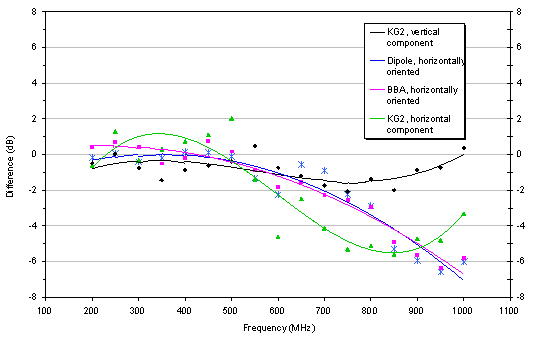
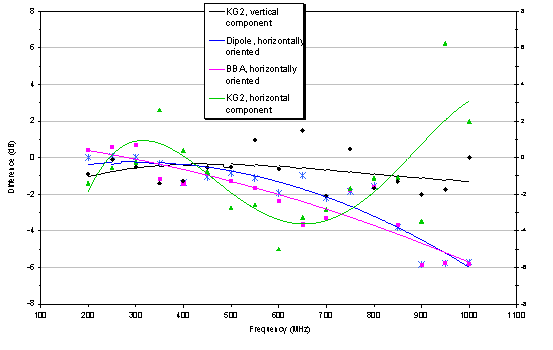
- for geometrically small EUT without any connected cables, the uncertainty can be estimated to be approx 0 dB at 200 MHz, falling to -6 dB at 1 GHz;
- for EUT with a connected cable, the uncertainty in the range from 200 MHz to 1 GHz can be estimated to increase with the frequency from approx ±1 dB to ±6 dB, with increasing variance.
Figures 1 and 2 serve to illustrate these estimates by showing the influence of the two discs in each model, given a relative permittivity of 4 and a distance of 7.5 cm.
|
|
Figure 1: Influence of the small disc with a relative permittivity of 4 for different radiation sources at a height of 90 cm
|
|
|
Figure 2: Influence of the large, round disc with a relative permittivity of 4 for different radiation sources at a height of 90 cm
|
- In the frequency range from 30 MHz to 200 MHz, the influence of the dielectric disc on field strength changes is noticeably smaller and is estimated at a maximum of +1 dB.
- It can generally be said that the less the measurement accessories penetrate into the direct electromagnetic field between the radiation source and the receiver, the smaller their influence on any measurement uncertainties. This could be taken into account and corrected through appropriate instructions for measurement set ups.
- In summary, it can be said that the determination of the relative permittivity of measurement accessories, assuming negligible conductivity, and also the determination of their reflection properties, taking account of their size and position, can be used as a suitable means of estimating the expected influence in OATS field strength measurements.
Measurements
Since the relative permittivity of the materials of measurement set ups and the environment was described as the major cause of effects, it is possible to estimate the influence of these objects by determining the relative permittivity and/or the phenomena caused by the relative permittivity.
In the simplest case, one effective method is to determine the permittivity at low frequencies in a capacitor with a measuring bridge and to conclude from this the influence in the frequency range of interest, taking into account the (low) frequency dependence of the permittivity of many materials. A considerably more accurate method to determine the permittivity is to make measurements in a resonator in the frequency range of interest. However, this method requires that the materials can be shaped into the form of the resonator.
A very effective and flexible measurement method was described in detail and tested as a further method for estimating the influence of measurement set ups and the environment. This method is suitable for studying existing mobile and immobile objects as well as materials that cannot or cannot easily be shaped. The relative permittivity of the materials examined causes discontinuities in the propagation medium and reflections and transmissions of electromagnetic waves. The measurement method described exploits these phenomena by measuring the back scattering in the time domain as a measure of the permittivity compared to electrically neutral materials, in order to qualitatively conclude from this the expected influence in field strength measurements. It was shown that Fourier analysis of the pulses backscattered by the objects allows statements to be made to a limited extent about the behaviour of the objects examined over the frequency range.
In the case of all three measurement methods, the conclusions drawn cannot take account of the influence of the measurement accessories through interaction with the EUT in the near field of the EUT.
Results of the study
Since the turntable is the main object in respect of the measurement uncertainties caused by measurement accessories in field strength measurements, all the analyses were made using the turntable as an illustrative example in primarily the frequency range between 200 MHz and 1 GHz. Evaluation of the results of the mutually complementary analyses allows the following estimates to be made:
Flat dielectric discs in the immediate vicinity of the EUT and with a relative permittivity larger than 3 cause height-dependent field strength changes of up to 20 dB at a distance of 10 m on an OATS. Even where a height scan is taken into account, measurement uncertainties of 5 dB can be easily proven.
Comparable effects are expected under free space conditions, but these were not investigated in the study.
Particularly critical is the effect of a reduction in the distance between the radiation source and the turntable on the increase in occurring field strength differences.
Relative material permittivities of > 2 are to be regarded as not tolerable in the case of distances smaller than 30 cm.
The measurement uncertainties caused by the (turn)table disc differ according to the radiation source.
Conclusions
The following conclusions can be drawn from the results of the analyses.
The relevant standards are to draw attention to the fact that in disturbance field strength measurements using dielectric materials with er > 2 for the turntable, considerable measurement uncertainties of up to 5 dB, depending on the EUT, are to be expected in the frequency range between 500 MHz and 1 GHz, if the distance between the EUT and the turntable is smaller than 30 cm. Measures are therefore to be taken to ensure that such materials are used in exceptional cases only, and that if such materials are used, the permittivity-related measurement uncertainty must be specified.
If such materials are used, a height scan is generally to be made in disturbance field strength measurements, including prescan measurements and measurements under free space conditions.
The relevant bodies should undertake to include in the relevant standards a more detailed description of the turntable, and to standardise a turntable applicable both to different field strength measurement procedures and to the immunity tests specified in various standards. The findings of this and other studies relating to, for example, specific measurement set ups, cable runs, and the use of absorbing clamps, should be taken into account in developing a common turntable model. Figure 3 illustrates a proposal for such a turntable.
Dielectric measurement set ups with a small backscattering surface and positioned at a sufficient distance from the EUT are seen to be non critical in respect of their influence on relevant measurement uncertainties in field strength measurements in the frequency range between 30 MHz and 1 GHz.
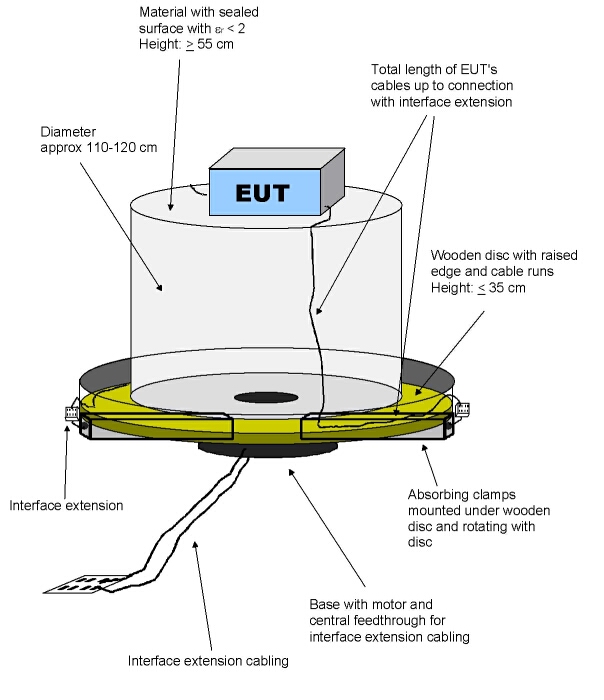
Figure 3: Sketch of a proposal for a turntable for field strength measurements and tests applicable to all standards
back
designed by Peter Mosshammer
last Update 16.09.2003